|
| |
 |
| |
| Component 1 - Health |
| Identification of Persons with Disabilities |
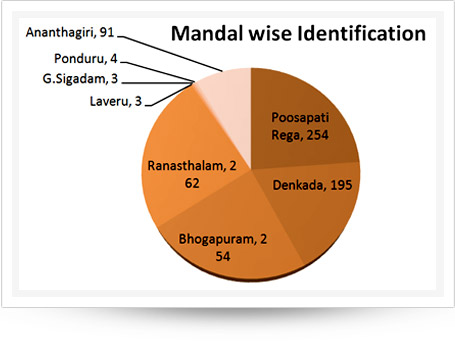
The first step is the active identification of children and youth with a disability: one of the aims of the program is to know every child in the area. The identification happens in a systematic way. Six outreach workers go to the villages and make a first investigation. Every outreach worker takes care of 50 villages with approximately 250 inhabitants. The second step is that the Medical Team, this is the Doctor, nurse and physiotherapist, visits the villages and diagnoses the children. This first diagnosis, the medical and other facts go into the newly developed database. |
| |
|
 |
|
| |
 |
 |
| Promotion |
We conducted promotion activities to get a positive response from the community for persons with disabilities. These activities are designed to involve the general community in the process of development of disabled persons. |
|
|
| |
| Scheme |
Total |
| Identification |
| Total |
1066 |
| Promotion and prevention |
| Parents meetings |
11 |
| Parents counseling |
964 |
| Community counseling |
270 |
| Awareness meetings |
50 |
| Counseling for young couples |
44 |
| Focused group discussions |
26 |
| Medical care |
| Regular medical checkups |
1177 |
| Specialist checkups |
462 |
| Testing in deaf and dumb camp |
88 |
| Testing in orthopedic camp |
104 |
| Physiotherapy |
39 |
| Individual care Lilianefund |
53 |
| Individual care FI Fund |
37 |
| Medication |
16 |
| Assistive devices |
| Wheel chairs |
96 |
| Hearing Aids |
8 |
| Orthotics |
64 |
| Locations |
| Villages |
326 |
| Mandals |
8 |
| Districts |
3 |
|
| |
| |
| |
|
| |
| Component 2 - Education |
| 3.2 Education |
The CBR matrix focuses to pay special attention to all phases of life. In 2010 the emphasis was the identification and the health support. In 2011, more emphasis on education. In 2011, 15 children are identified for support education. The children are provided with books, uniforms, bags and other stationery items under this support. 2 children were supported with school fees. All the children were regularly followed up by social workers. Our social workers are going to the schools, meeting the teachers and observing the child growth in the school. |
| |
| In 2010 the program reached the following groups: |
| S.No |
Education |
Total |
| 1. |
Primary |
27 |
| 2. |
Secondary and higher |
1 |
|
| |
|
|
|
| |
| |
| |
|
| |
| Component 3 - Livelihood |
We have concentrated activities under livelihood component. This includes skill development through our institution or sending to other centres, creating self employment opportunities, stabilizing wage employment and advocating with government for implementation of social protection schemes for persons with disabilities. |
| |
| S.No |
Livelihood |
Total |
| 1. |
Skills development Referreal CC |
72 |
| 2. |
Self employment |
1 |
| 3. |
Social protection |
102 |
|
| |
|
|
|
| |
| |
| |
|
| |
| Component 4 - Social |
We have not yet get involved in the activities under SOCIAL component. These activities are running parallel to other activities like counseling, family interaction and community interactions, organizing cultural and sport activities etc. We feel involving community stakeholders for SOCIAL protection of persons with disabilities will improve the quality of their lives. |
| |
|
|
|
| |
| |
| |
|
| |
| Component 5 - Empowerment |
We identified 15 existing self-help groups in the Ranasthalam Mandal. In the other Mandals we didn’t find any self-help groups. We attended to all the 15 self-help group meetings in this year. Next year we planned to form self-help groups in the remaining Mandals and strengthen all groups. |
| |
| S.No |
Empowerment |
Total |
| 1. |
Self-Help groups |
22 |
|
| |
|
|
|
| |



